Iter Floris #Diaspora Botanica
by Romy Berthold and Corinna Schwager
Iter Floris, a Digital Flower Bouquet project, emerges as a critical intervention as a decolonial archive. By creating 3D-scanned digital representations of decorative flowers and centering indigenous names, knowledge systems, and histories, this project challenges the epistemic violence embedded in how we know, name, and commodify plants. This blog post explores the theoretical foundations and practical methodologies of this decolonial digital archive—a space where flowers are liberated from the constraints of “Western” taxonomy and reconnected to the diverse cultural worlds they have always inhabited.
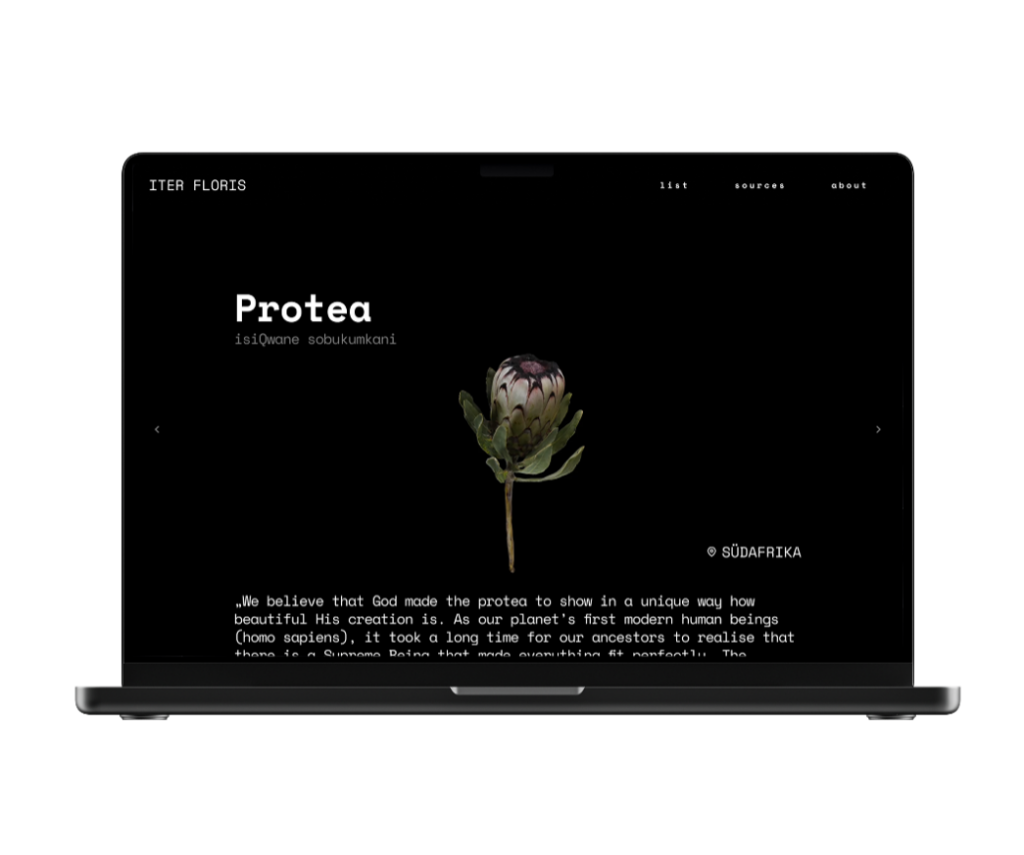
Project Description
Colonial botany was never merely a scientific enterprise; it was a systematic project of extraction, control, and knowledge appropriation that served imperial economic and political aims[1]. From the 17th century onward, European powers mobilized botanical knowledge to facilitate resource extraction, agricultural exploitation, and commercial dominance across colonized territories. Plants were catalogued not to honour the lifeways and healing traditions of local communities, but to identify which species could be profitably extracted, cultivated, and traded.
[1] Subramaniam, B., & Chatterjee, S. 2024.
The Politics of Naming
Through the process of colonial taxonomy, Latin botanical names are not neutral descriptors; they represent a Eurocentric claim to epistemic authority. By insisting that plants can only be “properly” known through their Latin names, Western science marginalizes the thousands of indigenous naming systems that have existed for millennia.
Consider the politics of naming: when a plant is “discovered” by a European botanist and given a Latin name, indigenous peoples who have cultivated, used, and named that plant for generations are rendered invisible. Their knowledge is reformatted, extracted, and repackaged as “scientific” knowledge, while their own epistemologies are dismissed as “folk knowledge” or “traditional beliefs”[2].
The result is a botanical archive that systematically privileges Western ways of knowing while erasing indigenous intellectual traditions. This erasure has material consequences: it facilitates “biopiracy”, undermines indigenous sovereignty over biological resources, and perpetuates the myth that only Western science produces valid knowledge about the natural world.
[2] Martins, L. 2021.
Colonialism patterns as a continuum
By researching the flowers’ colonial pasts we have recognized certain patterns:
- European renaming / Nomenclature / Displacement, Devaluation and Delegitimization of Indigenous Knowledge Systems
By framing indigenous knowledge as “belief” rather than “science,” Western institutions maintain their monopoly on truth-making authority. - Biopiracy / Plant Hunting / Theft of Knowledge
When indigenous medicinal knowledge is dismissed as unscientific, it becomes easier to appropriate this knowledge without compensation—through biopiracy, pharmaceutical research, or “ethnobotanical” studies that extract knowledge while giving nothing back. - Commercialization & Exoticization / Plants as Trophies
The contemporary global flower industry is not merely analogous to colonial extraction—it is a direct descendant of colonial trade networks and continues to operate according to colonial logics of exploitation and extraction. Historical botanical collections and colonial trade routes established the infrastructure for today’s floriculture industry. Plants that were “collected” (often stolen) from colonized territories, studied in European botanical gardens (like the British Royal Kew Gardens), and then cultivated in colonial plantations form the genetic basis of many commercial flower varieties today[3]. Within these botanical gardens they were displayed as trophies of imperial power that shall furthermore demonstrate the discovery of “the exotic”. - Ecological Destruction
Mass flower production carries enormous environmental costs. Through the colonial extraction, forests were devastated and ecosystems harmed. The intensive use of pesticides and fungicides contaminates soil, water systems, and ecosystems, with long-term consequences for biodiversity and human health. These environmental impacts disproportionately harm communities in the Global South while delivering aesthetic pleasure to consumers in the Global North. - Spiritual & Cultural Devaluation Plants are often part of peoples’ belief systems and carry an existential role in their cosmologies. Rather than being mere objects of display, plants can be recognized as kin, non-humans and entities. By being stolen through colonial forces, social orders can be heavily disrupted and it is crucial to repair this historical violence.
[3] Gibson, P. (2024)
Methodology
The Digital Flower Bouquet project employs a multi-stage technical process that integrates digital capture, 3D-modeling, and web-based presentation. As a preparation, we have visited a wholesale market for flowers to gain a broad overview of specimens, where they come from, and how they are distributed. After choosing the flowers, we captured them with Polycam, a 3D photogrammetry software. The 3D models are refined, optimized, and prepared for web presentation using Blender. After that, the 3D models are integrated into a website that serves as both an archive and an educational platform. The website presents each flower alongside its indigenous names, cultural histories, medicinal uses, and colonial contexts.
Project Members
Romy Berthold
- M.A. degree in Social and Cultural Anthropology
- Department of Social and Cultural Anthropology, University of Cologne
- Visual and Museum Anthropology
- romyberthold@outlook.de
Corinna Schwager
- Integrated Design B.A.
- Köln International School of Design
- @corinna.schwager
References
Gibson, P. (2024). Herbaria and Dark Botany. In: Di Paola, M. (eds) The Vegetal Turn. The International Library of Environmental, Agricultural and Food Ethics, vol 38. Springer, Cham.
Martins, L. (2021). Plant artefacts then and now: reconnecting biocultural collections in Amazonia. In F. Driver, M. Nesbitt, & C. Cornish (Eds.), Mobile Museums: Collections in circulation (pp. 21–43). UCL Press. https://doi.org/10.2307/j.ctv18kc0px.8
Subramaniam, B., & Chatterjee, S. (2024). Translations in Green: Colonialism, Postcolonialism, and the Vegetal Turn. Configurations 32(1), 1-23. https://dx.doi.org/10.1353/con.2024.a917006.