Becoming Hyphae #Diaspora Botanica
Questioning Perspective and the Invisible Mushroom by Lara Benz and Anna C. Schäfer
‘Becoming Hyphae’ is an anthropological design installation that invites people to question their perspectives and positions as humans and dive into the world of mushrooms and the invisible mycelium.
Emergence
The exhibition ‘Becoming Hyphae’ is the result of a long process of exchange between an anthropologist and a designer. The initial idea that brought the designer and the anthropologist together came from an observation that what people generally refer to as mushroom is just the tip of the iceberg, respectively the tip of the mushroom aka its fruiting body. Most parts of the mushroom remain under the surface, invisible to and unnoticed by most human beings. Consequently, common knowledge about mushrooms in their entirety is very limited and often only accessible to a small number of specialists like mycologists, botanists or biologists. Nevertheless, mushrooms are an integral part of our world and the ecosystem that they keep alive through symbiotic relations. As we survive because of the impact mushrooms have on the ecosystem and therefore also on the human livelihood, humans should have access to a more detailed knowledge about mushrooms and their impact.
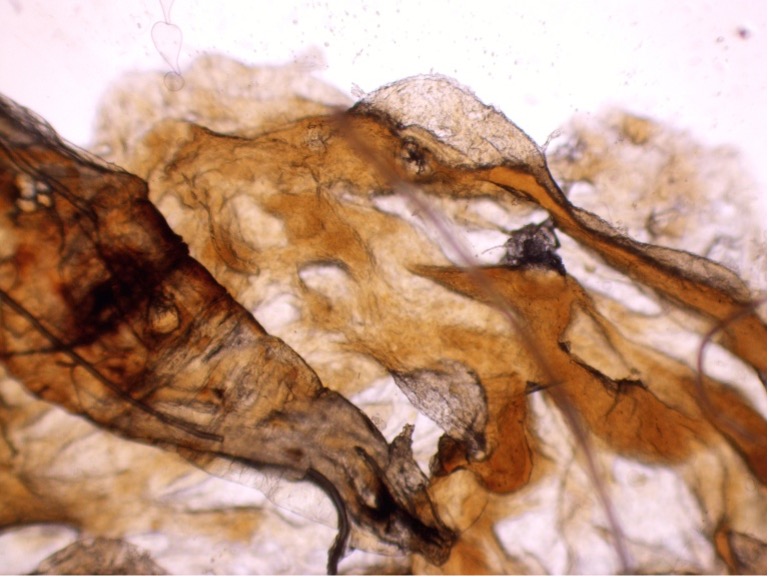
The Mycelium
Mushrooms are some kind of natural Black-Box-phenomenon of the ecological world. What we know and experience of the mushroom is often only the outcome of a long process of growth in a complex and dense meshwork.

This meshwork is what we call mycelium, the vegetative part of the mushroom that grows under the ground over large areas. It consists of very tiny single strings called hyphae that create a dense meshwork, and includes not only other fungi in its colonies but also other organic matter like roots, mould or seeds and forms a dense symbiotic meshwork under the ground. In the symbiosis, fungi and other plants and organisms exchange nutrients to keep each other alive. Mushrooms are also responsible to digest decaying organic material. That way, they keep our ecosystem alive.
Even though we know about the symbiosis of mushrooms and other species and how the mycelium grows from these, we do not know much about the processes of growth: why it grows in specific directions, why it forms partnerships with entities in a specific place at a specific time, how and why it communicates along these paths, and how and why it crosses specific boundaries. In most cases, the mycelium does not behave as we think it would. It seems like it has its own intentions that are yet to be studied.
The Social Life Cycle of a Mushroom
In a podcast interview in 2023, Tim Ingold explained that mushrooms and people are not so different from each other. None of their decisions are always only determined by outer conditions, like the weather or society, but they have individual intentions that guide their decisions[1]. These decisions and intentions are mostly invisible to humans but they are not inaccessible.
Anthropologists have made it their task to study individual decisions and intentions as well as the collective outcomes in the human world. The question then is: Can we study a mushroom’s intentions, decisions and the collective outcomes similarly? And if yes, how can we make these things accessible to our eyes and minds?
The classic anthropological method, participant observation, was unfortunately not possible as we could not turn mushrooms into humans and study them with our common methods. But we were able to turn humans into mushrooms through our installation. By doing so, we made visible and understandable what is otherwise hidden under the ground. Of course, we did not actually turn human beings into mushrooms but we put them in the mushroom’s position.
We created an interactive game-like installation that made often highly specialised knowledge about mushrooms accessible to a broad audience. Furthermore, it enabled us to observe the
interactions, connections and intentions of humans as mushrooms and get an idea of what might happen in the Black Box of the mushroom.
[1] The Land Behind Podcast by Peter Holliday: Episode 2 Tim Ingold: Ecologies of Perception. April 14th 2023. https://open.spotify.com/episode/2UkLIeyl69vt0cVJcqLljy?si=3ab84da1144a4fd7 [20.01.26]
Becoming Hyphae Exhibition
The Human Mycelium
Observing people during their journey allowed us important insight. Just like mushrooms people were communicating throughout their individual growing processes. They supported each other by pointing towards bonding partners that needed to be stepped on, by communicating the current weather conditions or by waiting for each other. Bonding partners were often shared but in some cases people had to search for another bonding partner instead. Some remained silent, others were loud. Some were confused where to go, while others had fun, laughed and shouted. “It’s like bingo!”, one visitor told us afterwards. “You never know when you will be able to move and then suddenly you have to because the conditions are right. Then you must shoot your shot.” Some went really fast, others went slower. Some made it to the finish line and others not.
Each individual drew their paths they walked in the ‘under the surface’-space on a transparent map. At the end of the installation, these maps were put together and projected on the wall. The final image was a meshwork of fine lines – a mycelium created by people who shortly changed their positions with that of a mushroom. What was most strikingly to us is that even though there were only three different mushrooms, each path that was drawn was different.

The outcome of our installation supports Tim Ingold’s and our assumption that people and probably also mushrooms are not only guided by outer conditions in their movements but also by their own intentions. The collective meshwork that is created is always unique, built of and by individual, intentional beings.
Following Ingold, we propose to study social systems like fungi – to follow each individual path and understand how people move and dwell in the world, how they cross boundaries and make decisions based not simply on social norms but on their own intentions. On the other hand, we also propose to study fungi from a social-science perspective and their mycelium not as a mycological phenomenon but as a social multi-species one. To understand both human and mushroom paths we sometimes need to shift our perspective and also question our own paths and intentions.
The Curators
Lara Benz is an Integrated Design student at KISD and Student Assistant in the field of Ecology and Design. Her interest lies in the field of sustainable and biodegradable materials, with a focus on vegan leather alternatives grown from fungi. Lara’s current work explores different applications of living organisms in her work in the forms of fashion, sculptures, and surface treatments.
Anna Céline Schäfer is a Social and Cultural Anthropologist at the University of Cologne and member of the interdisciplinary Research Consortium ‘Commodifying the Wild’. Anna’s research interests are located in sensory anthropology, political ecology and science and technology studies and focuses mostly on plant-human relations. Her current PhD research project explores the making of ‘wild’ commodities in a global fragrance industry. By tracing the value chain of an essential oil from Namibia to Europe and by exploring contexts of traditional and commercial perfumery she scrutinises the commodification of wilderness.
References
[1] The Land Behind Podcast by Peter Holliday: Episode 2 Tim Ingold: Ecologies of Perception. April 14th 2023. https://open.spotify.com/episode/2UkLIeyl69vt0cVJcqLljy?si=3ab84da1144a4fd7 [20.01.26]